
Why Mock Practice Is Important Before Appearing for the NISM Exam
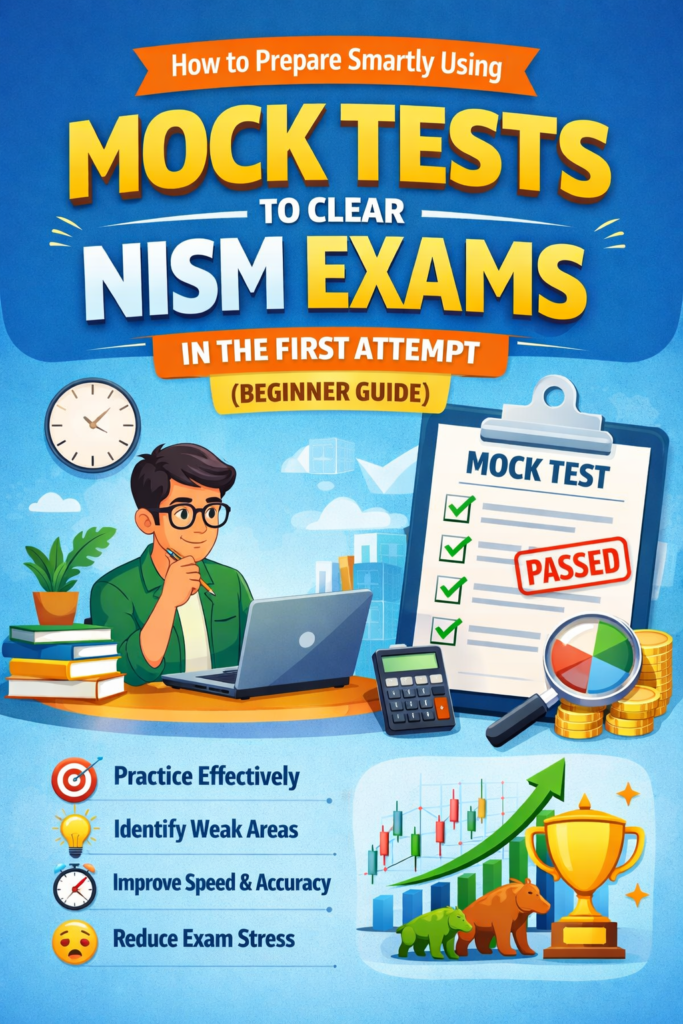
How to Prepare Smartly Using Mock Tests to Clear NISM Exams in the First Attempt (Beginner Guide)
Introduction
NISM (National Institute of Securities Markets) exams have become extremely popular among students and professionals who want to build a strong career in finance, stock markets, mutual funds, and wealth management.
At first glance, the syllabus may look simple. But in reality, many candidates fail the NISM exam not because they didn’t study — but because they didn’t practice the exam properly.
If you’re preparing for a NISM certification, mock tests are not optional. They are the smartest shortcut to clearing the exam in your first attempt. This beginner-friendly guide will show you exactly why mock practice is so important and how to use it effectively.
What Are NISM Exams?
NISM exams are online certification exams conducted by the National Institute of Securities Markets to test both conceptual understanding and practical application of financial market concepts.
These certifications are useful for:
Students entering the finance industry
Working professionals upgrading skills
Mutual fund distributors
Traders and investors
Compliance and operations professionals
Some popular NISM certifications include:
NISM Series VIII – Equity Derivatives
NISM Series V-A – Mutual Fund Distributors
NISM Series VII – Securities Operations
NISM Investment Adviser Modules
Why Mock Tests Are Crucial for NISM Exams
Many beginners make the mistake of only reading the study material. However, NISM exams are application-based, not memory-based.
Mock tests help you:
Understand the real exam pattern
Improve speed and accuracy
Identify weak and strong topics
Get comfortable with case-based questions
Reduce exam-day stress and anxiety
👉 Simply put, mock tests prepare your mind for the actual exam environment.
Step-by-Step: How to Use Mock Tests Smartly
1️⃣ Start Mock Tests After Basic Syllabus Coverage
You don’t need to finish 100% of the syllabus before starting mocks. Once you complete around 60–70% of the topics, begin attempting mock tests.
This helps you:
Understand how questions are framed
Identify high-weightage areas
Avoid surprises in the actual exam
2️⃣ Treat Every Mock Test Like the Real Exam
While attempting a mock test:
Sit in a quiet place
Set a timer
Avoid mobile phones and notes
This builds exam discipline and boosts confidence.
3️⃣ Analyze Every Mock Test Thoroughly
This is where most students go wrong.
After each mock test:
Review all incorrect answers
Understand why the correct option is right
Note down confusing or tricky concepts
👉 Remember: Analysis is more important than your mock score.
4️⃣ Use Topic-Wise Mock Tests
NISM exams include theory, numericals, regulations, and case-based questions.
Topic-wise mock tests help you:
Strengthen weak areas
Improve conceptual clarity
Avoid repeating the same mistakes
5️⃣ Revise Using Mock Test Mistakes
Maintain a small notebook or digital notes where you:
Write down frequent mistakes
Note tricky formulas
Highlight confusing regulations
Revising these notes before every mock can drastically improve retention.
Common Beginner Mistakes to Avoid
❌ Attempting too many mocks without proper analysis
❌ Ignoring numerical and calculation-based questions
❌ Skipping regulatory concepts assuming they are easy
Avoid these mistakes, and your chances of clearing the NISM exam in the first attempt increase significantly.
Final Tip for First-Time NISM Aspirants
Using PDF mock tests is highly effective because:
You can practice offline
Easy to revise multiple times
Perfect for last-week preparation
👉 The best strategy is: Study material + Mock tests + Deep analysis.
Conclusion
Clearing the NISM exam in your first attempt is absolutely achievable — if you prepare smartly.
Mock tests are not just practice tools; they are your exam strategy. Start early, analyze deeply, revise consistently, and walk into the exam with confidence.